Thursday, June 27, 2013

How to Kill Fox Tails and Wild Lettuce


Foxtails in an ugly mess of laurel, 4th Street between I and J, from the alley


Fox tails are beginning to ripen their seed all over town, mixed with cheat grass and other weeds, and infesting lawns.  It is a well-known sticker seed, sticking in pets’ fur and working its barbed seeds into their flesh.  Like cheat, it is a major fire hazard.  Its name describes the seed heads, looking like a fox’s brushy tail. 

Foxtails in boxwood


Like nearly all annual grasses, it is easiest to see and pull when it has seed stalks.    Unlike many of them, it grows full size-heads even after being mowed.   It stands out clearly in a lawn as it starts to ripen, yellow-green and ugly against the darker green of lawn grass.   
  

Foxtails in a Bermuda grass lawn


So does annual rye, but it is a lot smaller and nicer annual grass whose seeds don’t stick and can be smothered with an inch of compost because they are small.  Fox tail seeds are large and can come up through several inches of compost; heavy leaves are more effective, and a good way to stop them in flower beds.  But even light leaves can soften the soil and make it easier to pull weeds.

 Foxtails in permeable pavement, at Bimart.  How much do you want to bet they will grow there?


It is hard to pull mowed foxtails when they are dry in dry ground; water it and pull it before it gets to that point.  Gather up the stalks in each clump and give it a good yank; you will clear it out more quickly than you would think. 
 

Wild lettuce on city property
Wild lettuce is also starting to bloom all over.  It comes in several varieties, some uglier than others, all looking much like a dandelion with a tall, thick stalk.  It is the ugliest of weeds that spread their seeds on the breeze, and can grow head-high, adding to fire hazard.  The time to stop it, like all such weeds, is before those seeds ripen and become a nuisance rather than just an eyesore, spreading those seeds to the neighbors.


Wild lettuce on city property, with ashes, cheat, and dry bitter cress


It sticks hard in dry ground; to get the root, you will usually need to water the ground.  If you break or cut the stalk above the crown, it will grow more flowers ASAP.
Canada thistles are also showing up; they are much like wild lettuce except that they have sharp spines and blue flowers.  These can be cut below the crown with loppers or even just kicked out of the ground; the spines can make hand-pulling difficult, but by the time it is sending up flowers, it has little food in the root; young plants are easy to pull.
Take all seeding lettuce, dandelion, thistles, and other composites to a commercial composter; the seeds will continue to ripen and fly after they are pulled.
The best prevention for weeds is leaf mulch, which doesn’t make a good weed seed bed until it becomes soil.  What weeds do grow in leaves are easily pulled because the soil is fed and loosened.  Leaves should be cleaned off lawns, pavements, paths and buildings, and spread on soil, to feed and protect it.

Friday, June 7, 2013

Time to Kill Crab Grass


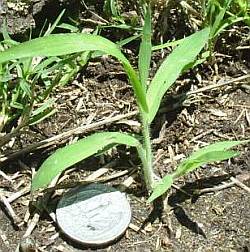
 Baby crab grass.  No other grass looks or grows like it.

Crabgrass is already starting to sprout as Heron’s Bill sets seed; it’s been a warm spring.  Now is the time to most easily get rid of it.  It is an annual relative of Bermuda grass and has the same kind of flower stalks, with four branches.
 Young Crabrass, flat spreading.  Credit: extension.entm.purdue.edu

Young crab grass, upright and easily pullable.  Credit: garden-counselor-lawn-care.com

Crabgrass breaks all the rules of annual weeds.  Most annuals are easiest to pull when flowering, because they have shrunk their roots in order to grow their flower stalks.  Crab grass is hardest to pull then, at least if it is well watered; it puts down strong, wiry roots from its stem joints as it flowers, and becomes even more firmly rooted.


Crab grass seed stalk.  Note the resemblance to Bermuda grass.   Credit: garden-counselor-lawn-care.com

Other weeds are more easily pulled from damp soil.  Crabgrass puts down deeper, stronger roots when it is growing in damp soil; in dry soil, it makes little root, living literally on dust and dew.
Right now, it is about an inch high in bare soil areas with lots of sun.  It’s still waiting to sprout in cooler areas.  Its seeds are fine; they don’t come up through mulch, though they will come up on top of it.  In areas where it is coming up or where you know it seeded last year, it is time to mulch or hoe it out. 
In lawns, an inch of compost will stop crab grass and other small seeds from sprouting, smother small weeds and moss, and feed the grass.  Cut the grass to one inch, cover with compost, and let the grass grow through it.  Keep the grass cut at 2 inches or more to keep weeds from invading.
          On open soil, it comes up thick, but mulch is easier to spread.  Cover it with 2 inches of compost, Walk-on fir (shredded bark-wood mix) or one inch of 4 x 8 sand (1/4-1/8 inch river sand).  (Avoid fine bark; it kills soil life.) 
Cover it with Walk-on, and your work is done.  In the sand, anything that sprouts can be cut or pulled below the crown with a hula hoe (aka scuffle hoe or stirrup hoe) and raked out.  You can use deeper sand, but it feel like walking on a beach.  You can also use the hula hoe on young weeds in bare soil if it is at all loose, but then you have bare soil to track around and grow the little buggers all summer.
          While it is easiest to mulch it out as or before it sprouts, it can be easily pulled until it flowers, and even then if the soil is not watered well.  Not that dry soil is good; other weeds are a pain in dry soil, from which they are hard to pull.
          You can also kill it when it is well-rooted, by cutting it below the crown with pruning scissors.  The roots, while wiry, have no food in them; cut off the plant, and they die in the soil.  This also works on puncture vine and star thistle in dry soil where they do not pull.

Published on Yahoo Voices
Rycke Brown, Natural Gardener        541-955-9040      rycke@gardener.com